Masters thesis topics
Condensed Matter Physics
Context
An extremely powerful and ubiquitous concept in theoretical physics is that of duality, loosely defined as a non-trivial physical equivalence between distinct theories. The existence of a duality is typically rooted in a common mathematical structure underlying seemingly very different theories. One appeal of dualities is that certain computations that are difficult in a given theory may be much easier in a dual theory. In the context of quantum lattice models, dualities have recently been classified and constructed in terms of tensor networks in one spatial dimension for closed boundary conditions [1,2,3]. This entanglement based approach to dualities has not only allowed for a concrete realisation of the operators implementing the dualities explicitly on the lattice but has also led to an understanding of how quantum phases of matter can be converted into each other.
An integrable quantum system is roughly speaking a system with an extensive number of conserved charges – local operators commuting with the Hamiltonian – to which they owe their exact solvability. Similar to dualities, tensor networks provide a natural language for describing integrable models, where the transfer matrix describing the model can be written as a matrix product operator and the central Yang-Baxter equation can be constructed following the fundamental theorem of matrix product states, a particular class of tensor networks [4].
Goal
Recent attention has been devoted to the fate of integrable models under duality transformations [5]. Both the transfer matrix of the integrable model and the duality operator can be described by a matrix product operator. Moreover, it has recently been proven that the central charges of the integrable model can likewise be encoded as matrix product operators [6]. The approach in [5] applies these duality transformations for integrable models with closed boundary conditions.
The goal of this project is to systematically construct dualities of integrable models on open boundary conditions extending the approach of [5], along with the explicit mapping of their conserved charges as defined in [6]. This project is well suited for a student with a keen interest in mathematical physics and entanglement theory.
References
[1] I. Cirac, D. Perez-Garcia, N. Schuch, F. Verstraete - arxiv: 2011.12127
[2] L. Lootens, C. Delcamp, G. Ortiz, F. Verstraete - arxiv: 2112.09091
[3] L. Lootens, C. Delcamp, F. Verstraete - arxiv: 2211.03777
[4] B. Vancraeynest-De Cuiper, W. Wiesiolek, F. Verstraete - arxiv: 2512.24390
[5] Y. Miao, A. Molnar, N. Jones - arxiv: 2602.17436
[6] P. Fendley, S. Gehrmann, E. Vernier, F. Verstraete - arxiv: 2511.04674
Context
The phase of a quantum wave function is usually a microscopic detail, yet in coherent systems, it can drive macroscopic behavior. The Josephson effect is perhaps the most famous example of this phenomenon, where a phase difference between two coupled fluids results in a measurable supercurrent. While typically associated with solid-state materials, the effect is a general feature of coupled quantum matter. In the context of ultracold atomic gases, this can be realized by coupling two internal hyperfine states of a Bose gas with an externally driven Rabi field. This coupling acts to synchronize the relative phase between the species, a process which reduces to pendulum-like dynamics in the mean-field limit [1].
In one dimension, however, phase coherence is suppressed by strong quantum fluctuations that prevent the formation of a macroscopic condensate. The system instead behaves as a Tomonaga-Luttinger liquid [2], where phase correlations decay algebraically. The low-energy physics of such a system is captured by an effective Sine-Gordon field theory [3] in the presence of weak Rabi coupling. This framework shows that while even an infinitesimal coupling pins the relative phase and opens an excitation gap, the quantum fluctuations strongly oppose this pinning. This leads to a renormalized scaling of the gap that deviates significantly from the prediction of mean-field theory.
Capturing this behavior goes beyond the reach of standard descriptions like the Gross-Pitaevskii Equation (GPE) [4], which treats the system as a classical object and ignores the non-trivial effects of many-body correlations. As an alternative, one may utilize the recently developed multi-component continuous Matrix Product State (cMPS) formalism [5] to resolve these effects. This approach is particularly powerful because the ansatz is parametrized by the bond dimension D, which acts as a direct probe of entanglement. This allows for a systematic study of how many-body correlations modify the Josephson physics as the system moves beyond the D=1 mean-field limit.
References:
[1] S. Raghavan et al., Phys. Rev. A 59, 620 (1999)
[2] M. A. Cazalilla, J. Phys. B 37, S1 (2004)
[3] Thierry Giamarchi. Quantum Physics in One Dimension, volume 121. Clarendon Press, Oxford, 2003.
[4] Lev Pitaevskii and Sandro Stringari. Bose-Einstein condensation and superfluidity, volume 164. Oxford University Press, 2016.
[5] W. Tang, B. Tuybens, and J. Haegeman, arXiv:2512.24998 (2025)
Goal
The goal of this project is to use the cMPS variational framework to characterize the ground-state properties of a Rabi-coupled 1D Bose gas and quantify the departure from mean-field theory directly in the continuum and the thermodynamic limit.
The project will begin with a literature study on one-dimensional quantum fluids. The student will familiarize themselves with the Lieb-Liniger model, Luttinger liquid theory, and the effective Sine-Gordon description of coupled systems. In parallel, the student will become acquainted with the theoretical construction and numerical implementation of the cMPS variational ansatz.
Building on this, the student will use the cMPS toolbox to investigate how quantum fluctuations renormalize the Josephson excitation gap. The focus will be on testing Sine-Gordon predictions through a finite entanglement scaling analysis in the weak coupling regime. This work will also involve quantifying the effect of inter-species interaction in the system.
This project is well suited for a student with a strong interest in theoretical and computatonal many-body physics. No prior knowledge of tensor networks or coupled bosonic systems is required.
Context
In 2023, a major breakthrough occurred with the experimental observation of high-temperature (Tc ≈ 80K) superconductivity in bulk samples of La3Ni2O7 (n = 2 in Fig. 1) at hydrostatic pressures above 14 GPa [1]. The pronounced structural and electronic differences compared to other unconventional superconductors have thereby inspired a plethora of theoretical studies aimed at uncovering the pairing mechanism in this layered nickelate. However, in these works, the simplified two-dimensional models proposed to study pairing order are not derived from first principles. This limitation restricts the electronic and structural insights they can provide for materials design toward stabilising superconductivity in nickelates under ambient pressure or at higher temperatures.
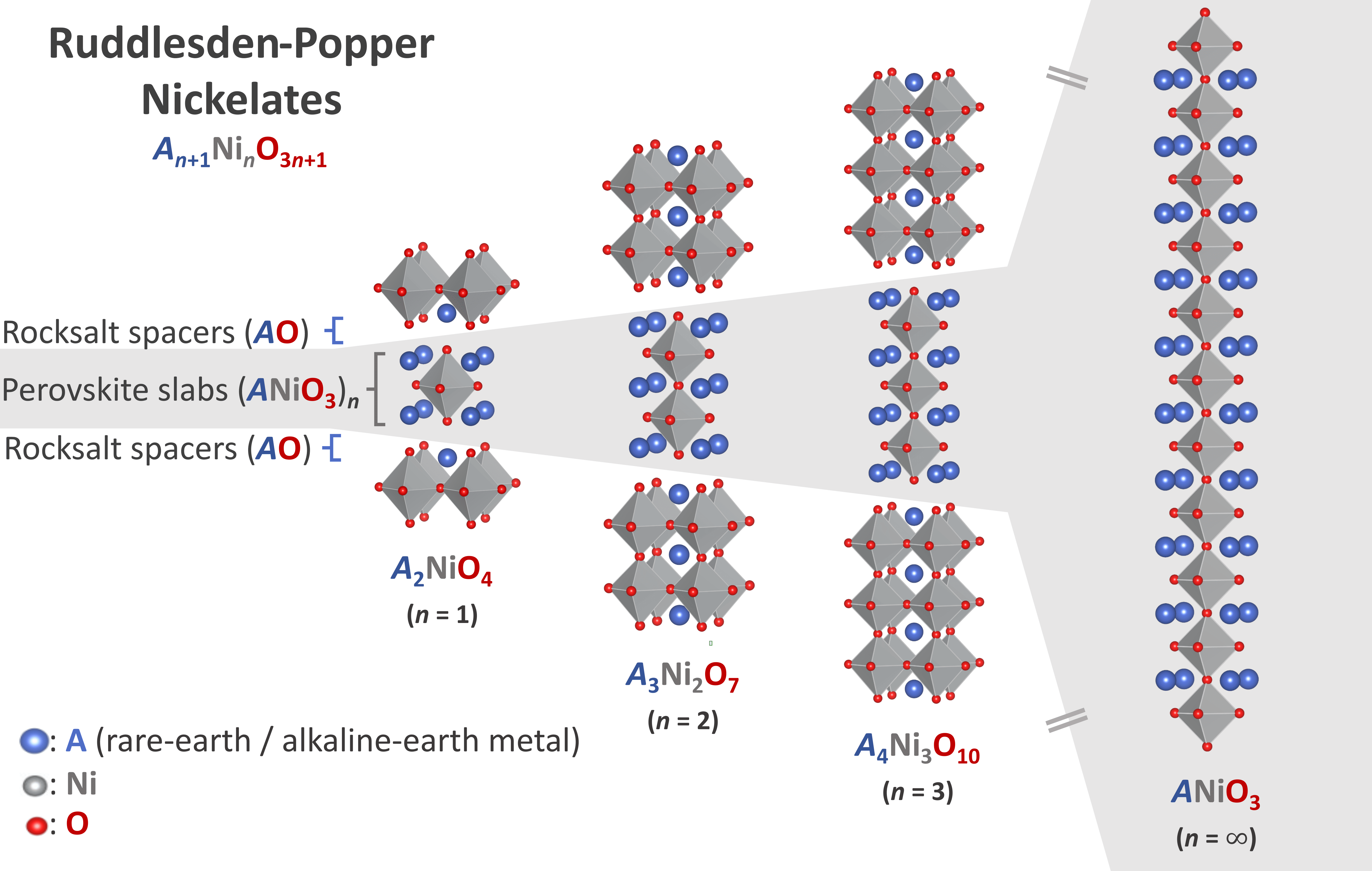
In recent work [2], we derived effective model Hamiltonians for the few relevant electrons in pressurised La₃Ni₂O₇ using the downfolding methodology [3]. The obtained low-energy models revealed a significant increase in on-site repulsion strength for the electronic bands crossing the Fermi energy, specifically in the pressure range where superconductivity is observed. This increase is attributed to a pressure-driven interplay between orbital localisation and competing screening channels arising from structural variations. These findings pave the way towards the deliberate design of superconductivity in the Ruddlesden-Popper nickelate series An+1NinO3n+1 (Fig. 1), in which the A-site cation, layer index n and (anisotropic) pressure-dependence provide rich flexibility. This is the objective of this ambitious and highly relevant dissertation.
Goal
The goal of this Master’s dissertation is the structural design of An+1NinO3n+1 by studying the influence of chemical substitution, different stoichiometries (n) and polymorphism, as well as the influence of epitaxial compression on the low-energy physics. First, density functional theory (DFT) and molecular dynamics simulations will be performed to understand the crystal structure of these quasi-2D compounds. Using the resulting in situ crystal structures as a starting point, we will analyse the strongly correlated subspace of the electronic structure, as it plays a dominant role in the superconducting state. Over the past four years, a downfolding renormalisation framework has been actively developed within our group, providing the student with established methods to construct effective Hamiltonians for the few strongly correlated electrons by computing the screening effects of the other “high-energy” electrons. The resulting model parameters will gain first-principles insights into the correlations of these compounds and will allow to reverse engineer towards a stable superconducting phase at ambient pressure or higher temperatures.
To gain familiarity with DFT and downfolding techniques, the student will first apply them to monolayer La2NiO4, as well as La3Ni2O7 in its metastable polymorph featuring monolayer-trilayer structures, and trilayer La4Ni3O10, the latter two of which have shown signs of unconventional superconductivity under pressure. This will enable an ab initio comparison of the superconducting phase with our recent results on bilayer La3Ni2O7. Once the downfolding methodology for these quasi-2D models is well established, it will be extended to more complex nickelates through chemical substitution at the A-site and the application of anisotropic pressure, which can be achieved experimentally via epitaxial compression.
[1] Sun H. (2023) doi:10.1038/s41586-023-06408-7
[2] Verraes D. (2025) arxiv:2502.19501
[3] Hirayama M. (2017) doi:10.1103/PhysRevB.96.075102
Context
Understanding the interplay between interactions and disorder is a central problem in condensed matter physics. While clean one-dimensional bosonic systems are well described by Luttinger liquid theory and exhibit the well-known superfluid–Mott insulator transition, the presence of disorder fundamentally alters their behaviour. Even weak randomness can destabilise long-range coherence and generate new quantum phases that have no analogue in clean systems.
A paradigmatic model capturing this physics is the disordered Bose–Hubbard chain. In addition to the superfluid and Mott insulating phases, disorder induces the Bose glass phase, which is insulating yet gapless and compressible. Unlike conventional phases, the Bose glass is characterised by strong spatial inhomogeneity and the presence of rare regions that locally resemble different phases. As a result, its physical properties are governed by broad distributions of observables and rare fluctuations rather than uniform bulk behaviour.
Renormalisation group [1] approaches suggest that disorder-driven transitions in one dimension may be governed by strong-disorder fixed points with unconventional scaling properties. In these regimes, rare-region (Griffiths) effects play a dominant role, leading to anomalous dynamical behaviour and broad distributions of energy scales. Despite substantial theoretical work, several fundamental questions remain open. In particular, the precise nature of the superfluid–Bose glass transition is still debated, including the universality of its critical behaviour and the role played by rare regions. Understanding how these features manifest in physical observables such as correlation functions, entanglement properties, and dynamical response remains an active area of research.
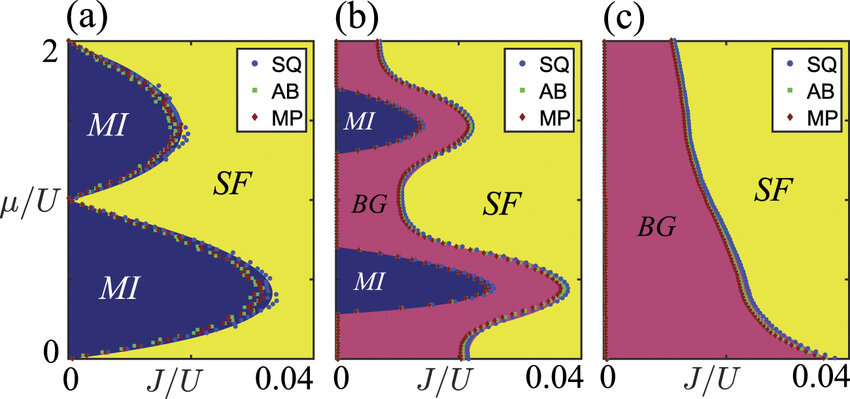
Numerical simulations are essential for addressing these questions. One-dimensional systems are particularly well suited to tensor network methods [2], which provide efficient representations of weakly entangled quantum states. Matrix product state techniques enable accurate calculations of ground-state properties, correlations, and entanglement for system sizes far beyond exact diagonalisation. Recent algorithmic developments for disordered systems, such as those introduced in [3], further improve the stability and efficiency of tensor network simulations in strongly inhomogeneous settings.
References:
[1] M. Fisher, Phys. Rev. B 40, 546
[2] J. I. Cirac, D. Pérez-García, N. Schuch, F. Verstraete, arXiv:2011.12127
[3] K. Vervoort, W. Tang, N. Bultinck, arXiv:2504.21089
Goal
The goal of this project is to study disordered bosonic chains using tensor network methods, with a focus on the physics of the Bose glass phase and the critical behaviour of disorder-driven transitions.
The project will begin with a literature study introducing the theoretical framework of one-dimensional bosonic systems. The student will familiarise themselves with Luttinger liquid theory, the Bose–Hubbard model, and the superfluid–Mott insulator transition in clean systems. The effects of disorder will then be explored, including the emergence of the Bose glass phase, renormalisation group descriptions of disordered systems, and the role of rare-region physics in low-dimensional quantum matter. In parallel, the student will become acquainted with tensor network techniques for bosonic lattice models.
Building on this background, the student will use the extensive tensor network toolbox for simulations of disordered Bose–Hubbard chains and use them to investigate the properties of the different phases. Particular attention will be given to identifying signatures of superfluid, insulating, and glassy behaviour through correlation functions, compressibility, excitation gaps, and entanglement entropy. The transition between the superfluid and Bose glass phases will be studied in detail, with the aim of probing its scaling behaviour and identifying possible signatures of strong-disorder physics.
This project is well suited for students with a strong interest in theoretical and computational condensed matter physics. It combines concepts from quantum many-body theory, statistical mechanics of disordered systems, and modern numerical methods. No prior knowledge of tensor networks or disordered bosonic systems is required.
Context
Classifying and understanding phases of quantum many-body systems is one of the central goals of modern condensed matter physics. While clean, translationally invariant systems have been studied extensively and are often well understood, real-world materials inevitably contain disorder. Randomness in microscopic couplings can fundamentally alter low-energy physics, giving rise to new universality classes, unconventional critical points, and exotic phases such as infinite-randomness fixed points and Griffiths phases.
Random spin chains provide a paradigmatic setting in which disorder plays a decisive role. A celebrated example is the random Heisenberg or transverse-field Ising chain, where renormalisation group [1] approaches reveal that disorder can drive the system toward strong-disorder fixed points with activated dynamical scaling and broad distributions of observables. In these systems, universal behaviour emerges not despite, but because of, the flow toward increasingly broad coupling distributions under renormalisation.
However, an important conceptual and practical question remains only partially understood: to what extent do microscopic details of the disorder distribution affect universal behaviour and observable quantities in finite systems? While universality suggests insensitivity to short-distance details, numerical simulations necessarily probe finite-size systems and finite disorder realisations. In this regime, properties such as the shape of the coupling distribution (e.g. Gaussian, box, power-law, log-normal), its tails, and correlations between couplings may strongly influence convergence, entanglement growth, and numerical stability.
Tensor network methods [2], in particular matrix product states (MPS) and related algorithms, provide one of the most powerful numerical frameworks to study one-dimensional quantum systems. They allow efficient representation of low-entanglement states and enable precise computations of ground-state properties, entanglement entropies, correlation functions, and dynamical observables. Recently developed tensor network techniques for disordered systems by our group [1], significantly enhance our ability to simulate random spin chains at large system sizes and for broad disorder regimes.
These advances open the possibility to systematically investigate how microscopic disorder distributions influence both (i) the emergent universal behaviour of random spin chains and (ii) the numerical performance and stability of tensor network algorithms themselves.
References:
[1] M. Fisher, Phys. Rev. B 40, 546
[2] J. I. Cirac, D. Pérez-García, N. Schuch, F. Verstraete, arXiv:2011.12127
[3] K. Vervoort, W. Tang, N. Bultinck, arXiv:2504.21089
Goal
This project will investigate random quantum spin chains using tensor network techniques, with a particular focus on the interplay between microscopic disorder distributions, universal low-energy behaviour, and numerical performance.
First, the student will familiarize themselves with our extensive numerical toolbox. In addition the student will explore the existing literature about renormalisation group approaches to disordered systems (e.g. strong-disorder RG) and tensor network methods for one-dimensional quantum systems.
Second, the student will implement and benchmark tensor network simulations of prototypical random spin chains (e.g. random Heisenberg or transverse-field Ising models). Different classes of disorder distributions will be systematically explored, and their effect on physical properties like entanglement entropy scaling, correlation functions and effective critical exponents, … . In addition the effect of the distributions on the convergence and stability of the numerical methods will be studied.
The project will be carried out in an international research environment. This project is well-suited for students with a keen interest in quantum physics and numerical simulations.
Context
One of the most exciting developments in modern quantum physics has been the discovery of topological phases of matter, whose exotic properties are robust against local perturbations and whose classification bridges the fields of topology and quantum physics. Photonic systems have emerged as a powerful and flexible platform for exploring such phases in a highly controllable setting [1]. A particularly fruitful technique in this and many other areas is Floquet engineering, where periodic driving is used to tailor the time-averaged dynamics of a system to realize a Hamiltonian of interest. One compelling application of this idea is the creation of synthetic dimensions: by coupling internal states of the system through a carefully designed driving protocol, one engineers an effective lattice dimension along those internal states. In photonic ring resonators, only a discrete evenly spaced set of frequencies is held by the resonator. Periodic modulation can coherently couple these modes, with each frequency then acting as a site along the synthetic dimension [2]. Extending this construction by coupling a 1D array of resonators adds a real spatial dimension, and the resulting hybrid system supports effective magnetic fields acting on the photons, opening up the possibility of realizing the paradigmatic quantum Hall effect in a photonic setting [2]. Beyond its fundamental interest as a quantum simulation platform, such a system supports unidirectional topological edge states that are inherently robust, making it equally relevant for practical applications in photonics engineering.
Goal
The goal of this project is to build a theoretical and numerical understanding of the quantum Hall strip realized in coupled ring resonators, with a concrete experimental implementation in mind. The student will first work through the theoretical background needed to understand the setup including topological band theory and the bulk-boundary correspondence, Floquet theory, and how synthetic dimensions are constructed in photonic ring resonator systems. With this in hand, the student will numerically model a specific realization of a band structure spectroscopy measurement along the synthetic dimension, after extending the protocol from [3]. A central question is which features of the bulk and edge states show up clearly in such a measurement and what experimental conditions are needed to resolve them. The model is then extended to include practical imperfections such as fabrication disorder, optical loss, and driving errors, to see how robust the results are. This project benefits from close collaboration with the photonics research group who will provide experimental guidance and context throughout. It is well suited for students who are excited by the prospect of connecting abstract ideas from topological quantum matter to a concrete and timely photonic platform.
References:
[1] Ozawa, T. et al., ”Topological photonics”, Rev. Mod. Phys. 91, 015006 (2019).
[2] Yuan, L. et al., ”Synthetic dimension in photonics,” Optica 5, 1396-1405 (2018)
[3] Dutt, A., et al., ”Experimental band structure spectroscopy along a synthetic dimension.” Nat Commun 10, 3122 (2019).
Context
Classifying quantum phases of matters is one of the most significant objectives in condensed matter physics. By understanding the physical properties and their mechanisms, we can design the materials for our purposes. Yet, the macroscopic mechanism is often not obvious from the microscopic models, making it a challenging task for physicists. One strategy is to look at the phase boundaries. There, the systems often exhibit universal properties that reflect the underlying macroscopic models. The renormalisation group (RG) is an idea that captures this: we can classify universality classes of models sharing universal properties at phase boundaries, which are fixed points of RG flows.
RG flows can capture various phase transitions. In particular, fixed points of second-order phase transitions can often be described by a conformal field theory (CFT), which unlocks a powerful toolbox to understand universality classes. First-order phase transitions, on the other hand, do not show the necessary conformal invariance to accurately be captured by a CFT. However, it has been known historically that some weakly-first order phase transitions such as that of the five-state Potts model, exhibit approximate conformal invariance. Recently, such phase transitions has been shown to be still described by an analytic continuation of CFTs, called complex CFTs [2, 3]. These have been shown to be applicable in various condensed matter/statistical physics systems, as well as in high-energy physics.
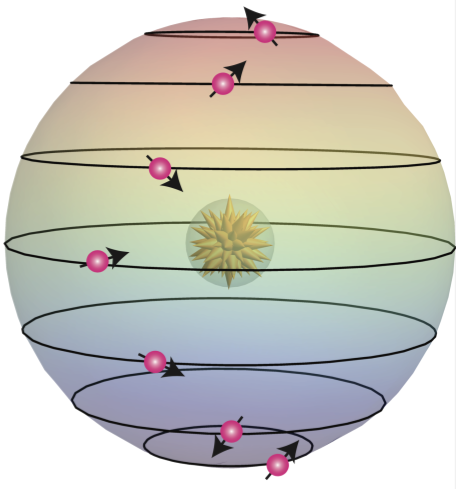
CFTs are analytically tractable in two dimensions due to conformal symmetry considerations. For this reason, most of the works in the literature studying critical lattice models do so in two dimensions. However, numerics allow us to access various conformal data in other dimensions, notably in 3D. One such development is the fuzzy sphere regularisation, which has proven to detect the fingerprints of CFTs accurately [4], and opens the gateway to realisations of various 3D CFTs. In particular, a possible connection to complex CFTs has been made with the 3-state Potts model in 2+1D [5], where the phase transition is first-order, but shows approximate conformal invariance.
Goal
This project will start off with a literature study into the relevance of complex conformal field theories in condensed matter contexts. The student will first familiarise themselves with real CFT, and how these are related to criticality and renormalisation group. Afterwards, the student is fully equipped to tackle complex CFT. Finally, the student is asked to perform some original work related to [4], which can be approached from various angles, and especially from the numerical point of view. Tensor networks, a most popular theoretical and numerical toolbox that has been developed in our research group to study strongly correlated quantum systems, will come into play on the fuzzy sphere.
The project can be tailored to the wishes and interests of the student in terms of which research topics they want to delve into.
This project is well-suited for students with a keen interest in mathematical, theoretical and computational physics. No prior knowledge on any of the mentioned topics above is required; a large part of this project concerns understanding these connections more deeply.
[1] D. Kaplan, et al., PhysRevD.80.125005
[2] V. Gorbenko, et al., arXiv:1807.11512
[3] V. Vander Linden, et al., arXiv:2507:14732
[4] W. Zhu, et al., PhysRevX.13.021009
[5] S. Yang, et al., arXiv:2501.14320
Bose-Einstein condensate
Context
The Bose-Einstein condensate (BEC) is a phase of matter, consisting of many (+10.000) interacting ultra-cold bosonic atoms in the quantum regime. The collective quantum many-body nature of the BEC gives rise to peculiar emergent behavior, admitting topologically non-trivial excitations such as vortices and solitons, linked to superfluidity. Solitons are localized waves that propagate without losing their shape thanks to the balance between nonlinear and dispersive effects in a medium. They can be observed in various situations such as shallow water, fiber optics and, indeed, superfluids. It is the latter context that we want to explore with this thesis.
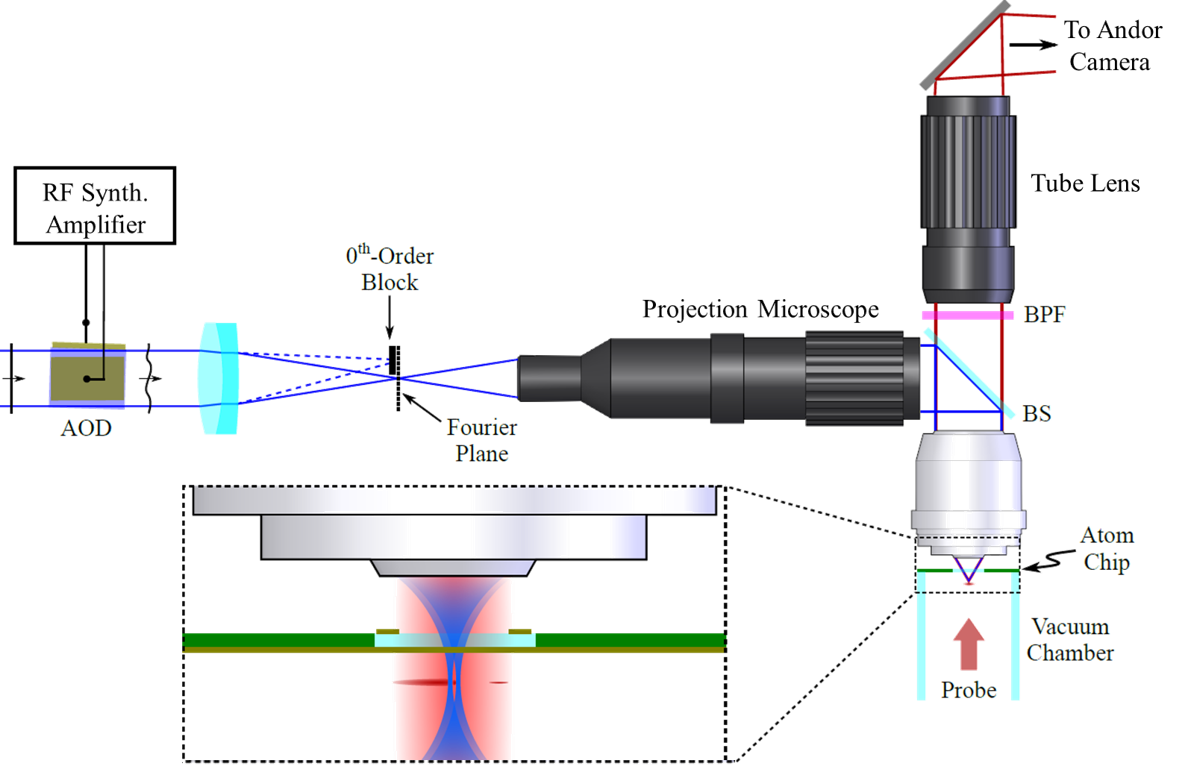
Already in 2000, 5 years after the first creation of a BEC, solitons were generated in these systems, see Ref [1]. The procedure consisted of laser-imprinting an appropriate phase difference onto the BEC wavefunction. In recent years, the spectacular advances in experimental techniques have facilitated a higher degree of control and manipulation of atomic gases enabling more finetuned protocols. In Ref [2] they demonstrate a technique to create more versatile soliton-settings, paving the way to study more involved soliton-physics such as multiple solitons interacting.
Since 2022, our group hosts a state-of-the-art experiment where BECs can be manipulated with programmable laser light and magnetic fields.
![Example soliton from [2]](/images/thesistopics/2026/CTanghe1.png)
[1] J. Denschlag et al. Generating Solitons by Phase Engineering of a Bose-Einstein Condensate.Science 287,97-101(2000). doi:10.1126/science.287.5450.97
[2] Fritsch, A. R. and Lu, Mingwu and Reid, G. H. and Pineiro, A. M. and Spielman, I. B. Creating solitons with controllable and near-zero velocity in Bose-Einstein condensates. Phys. Rev. A 101, 053629 (2020). doi:10.1103/PhysRevA.101.053629
Goal
The goal of the thesis is to study and engineer methods as described in Ref [2] in our own lab with the aim to create solitons at arbitrary position and velocity. As such, the student has the opportunity to develop and apply numerical methods and quantum optics theory on a cutting-edge quantum experiment.
The student will start by familiarizing themselves with the theoretical description of solitons in BECs. Using existing numerical packages, example experiments can be simulated. Once the physics behind the protocol is understood, the student will adapt it to our experimental set-up. Since our system uses a different light-shaping technique, namely Acousto Optic Deflectors (AODs) instead of Digital Micromirror Devices (DMDs) as in Ref [2], the student will engineer different optimal protocols suited to the actual experiment.
This thesis draws from different fields: quantum optics, quantum field theory, numerical analysis and cold atom physics. As the thesis fits within a larger research goal of our group, depending on their interests and skills the student will have the freedom to focus more on the theoretical, numerical or experimental part of the project.
Context
Quantum field theory underlies our description of quantum many-body systems. It is probably best known for its crucial role in the Standard Model of elementary particle physics, that is probed experimentally by gigantic instruments like the Large Hadron Collider. In recent years, ultra-cold atom experiments like ours have emerged as an entirely new platform for probing quantum fields directly in room-sized labs. At submicroKelvin temperatures a many-body (+10.000) system of bosonic atoms forms a Bose-Einstein condensate (BEC), which indeed realizes a controlled bosonic quantum field that can be manipulated with electromagnets and lasers; and that can be imaged with high resolution.
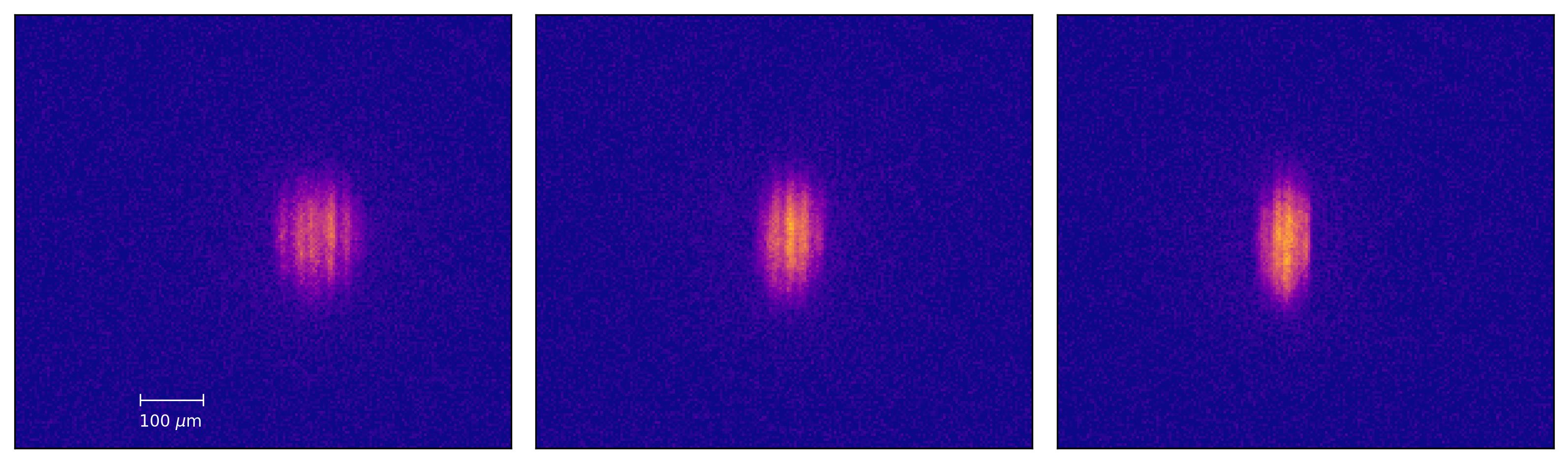
Depending on the geometry of the trap that confines the cold atoms, the BEC will behave differently. In the first historic traps, it is well described by a coherent mean-field, in some sense analogous to the classical electromagnetic description of a laser field. The more recent type of atom-chip traps, like we have in our system, realize a quasi 1D cigar-shaped geometry, in which the statistical nature of the underlying quantum field becomes more pronounced. In particular, in such traps the BEC exhibits large phase fluctuations that degrade the coherence. This leads to modulations in the density profile after ballistic expansion. Importantly, these density modulations can be used as a probe of the internal structure of the system, like the temperature in the equilibrium case, or the mode distribution in a non-equilibrium process.
Goal
The overall goal of the thesis is to study the phase fluctuations of condensates in our own lab.
After a warm-up in BEC physics, see e.g. [1] or [2], a first research task will be a thorough study of the analysis and underling theory for the experimental phase fluctuation observations of [3] and [4]. An open problem here, on which we want to make progress, is the theoretical treatment of the cross-over regime between effective 1D traps and 3D traps.
At a second stage we want to turn to the analysis of our own experimental data and study to what extent the temperature of the system can be measured from the power spectrum of the phase fluctuations as inferred from the density modulations after ballistic expansion.
Finally, depending on the progress, we want study the optimal engineering of quench/disruption protocols with a projected light-field, for instigating interesting non-equilibrium processes that can again be measured from the (time-evolution of) the power spectrum, e.g. like in [3].
This thesis draws from different fields: quantum optics, quantum field theory, numerical analysis and cold atom physics. The thesis aligns directly with the research goals of our group and throughout the project the student will interact with the different members - theoretical and experimentalistal physicists and have the opportunity to be directly involved in a state-of-the-art quantum experiment.
[1] Jacques Tempere, cursus UAntwerpen, Superconductivity and Superfluidity.
[2] L.Pitaevskii and S.Stringari, Bose-Einstein Condensation and Superfluidity, Oxford University Press (2016).
[3] Schemmer et al. Monitoring squeezed collective modes of a one-dimensional Bose gas after an interaction quench using density-ripple analysis. Phys. Rev. A 98, 043604 (2018). doi:10.1103/PhysRevA.98.043604
[4] Shah et al. Probing the Degree of Coherence through the Full 1D to 3D Crossover. Phys. Rev. Lett. 130, 123401 (2023). doi:10.1103/PhysRevLett.130.123401
Computational Quantum Many-Body Physics
Context
The search for new functional quantum phases is a central theme in condensed-matter physics, driven by the desire understand how strong electronic interactions and quantum mechanics conspire to produce unexpected collective behaviour. Among the most intriguing of these phases are quantum spin liquids: highly entangled states that evade conventional symmetry breaking even at zero temperature [1]. Unlike ordinary magnets, their electron spins remain in a fluctuating, liquid-like state, stabilised by strong quantum to fluctuations and geometric frustration. The triangular lattice provides a canonical setting for such physics: antiferromagnetic interactions on this geometry cannot all be satisfied simultaneously, giving rise to frustration, competing ground states, and a rich landscape of possible behaviours, including Mott insulating, metallic, and spin-liquid regimes.
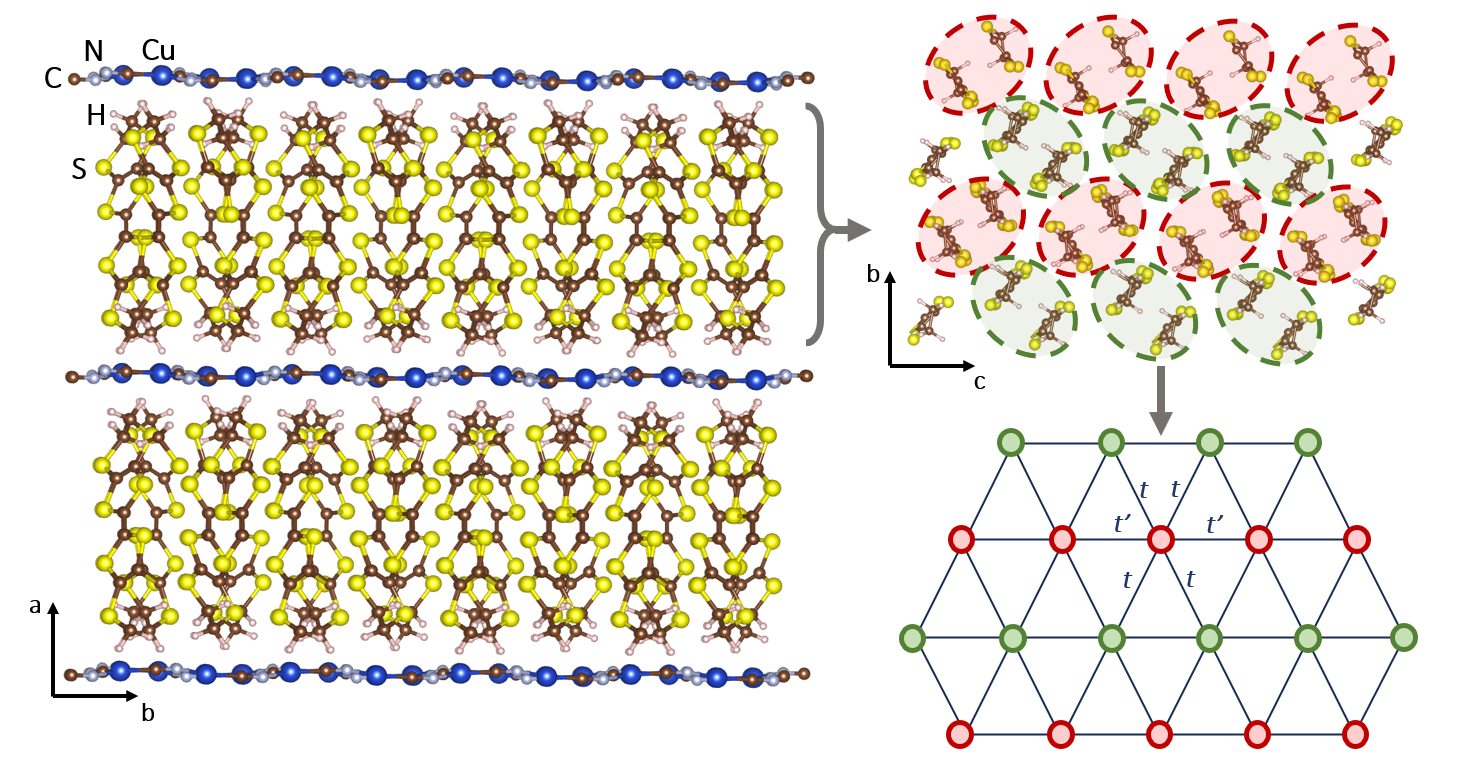
Since 1991, a prominent material candidate realising this landscape is κ-(BEDT-TTF)₂Cu₂(CN)₃, an organic charge-transfer salt whose low-energy electronic structure is well described by half-filled bands on an anisotropic triangular lattice of BEDT-TTF dimers (Fig. 1) [2]. At ambient pressure, it exhibits a Mott insulating state widely regarded as a quantum spin-liquid candidate. Upon applying pressure, the bandwidth increases relative to the on-site Coulomb repulsion, effectively tuning the ratio and driving the system across a metal-insulator transition, with superconductivity emerging at intermediate pressures. However, how pressure alters the effective interactions, and whether the corresponding simplified two-dimensional model accurately captures the resulting phases, remains unresolved, yet crucial for guiding the design of new functional materials.
The reason is that ab initio simulations for these types of materials are notoriously difficult, because they exhibit very strong electron correlations. Indeed, typical methods such as density-functional theory (DFT) fail in the presence of strong correlations and more accurate methods become unwieldy very quickly for realistic materials. Recently, the group of Profs. Frank Verstraete and Jutho Haegeman on the one side and the group of Prof. Veronique Van Speybroeck have teamed up for tackling precisely this question. The strategy is to use advanced ab initio methods such as extensions of DFT, GW-methods and random-phase approximations to derive effective models for the electron bands that exhibit strong correlations, resulting in a (extended) Hubbard model describing these bands. Afterwards, variational entanglement-based methods (known as tensor-network methods) can be used to solve this effective model in the regime of strong electron correlations.
Goal
In this thesis, the goal is to get more insight into both the Hubbard model on the triangular lattice and the physics of strongly-correlated materials with a triangular geometry. This means that we will construct effective models for κ-(BEDT-TTF)₂Cu₂(CN)₃ at different hydrostatic pressures. The resulting triangular-lattice Hubbard model (Fig. 1) will be solved using tensor networks to probe the pressure-driven stability of the different phases.
In the literature, there is a well-established tensor-network method for simulating these types of model, which boils down to placing the triangular-lattice model on a cylindrical geometry and using matrix product state (MPS) techniques for solving this effective one-dimensional model. Although quite successful, this method scales exponentially with the cylinder circumference, and it is unclear whether the physics is accurately represented by this method.
In order to have a more systematic approach, the full two-dimensional model can be solved with tensor networks using the formalism of projected entangled-pair states (PEPS). While previous methods have done this by mapping the triangular to a square lattice, which breaks the lattice symmetry, we will develop a methodology where we tackle the model directly on the infinite triangular lattice [3].
During the course of the thesis, the student will develop a performant framework to simulate the physics of the triangular-lattice Hubbard model, which is still under heavy debate in the community. This involves both code to find the ground state of the Hubbard model and code to calculate its physical properties. If this first part is successful, the student can proceed to simulate the physics of the effective models for κ-(BEDT-TTF)₂Cu₂(CN)₃ at different hydrostatic pressures. Furthermore, the methodology as developed by the student will serve as an integral part of the global strategy for the ab initio simulation of triangular-lattice materials.
[1] Anderson, P. W. (1973). Resonating valence bonds: A new kind of insulator? Materials Research Bulletin, 8(2), 153–160. https://doi.org/10.1016/0025-5408(73)90167-0
[2] Pustogow, A. (2022). Thirty-Year Anniversary of κ-(BEDT-TTF)2Cu2(CN)3: Reconciling the Spin Gap in a Spin-Liquid Candidate. Solids, 3(1), 93-110. https://doi.org/10.3390/solids3010007
[3] Naumann, J., Eisert, J., & Schmoll, P. (2026). Variational optimization of projected entangled-pair states on the triangular lattice. Physical Review B, 113(4). https://doi.org/10.1103/g5gm-tzf8
Context
Solving strongly correlated quantum systems is notoriously difficult, but nevertheless very important to unravel the mysteries behind high-temperature superconductvitiy and strange quantum phases like spin liquids. One of the most widely-used models to describe the properties of stronlgy-correlated materials is the Hubbard model. It describes fermions hopping on a lattice, with a hopping term and a repulsive term [1]
\(H = -t \sum_{<i j> \sigma} \left(\hat{c}_{i \sigma}^\dagger \hat{c}_{j \sigma} + h.c.\right) + U \sum_i \hat{n}_i \hat{n}_j\).
However, solving this model remains a significant challenge, leading to the development of numerous computational approaches. Among these, Tensor Networks (TN) have emerged as a powerful tool, explicitly capturing strong correlations without suffering from the sign problem (like Quantum Monte Carlo methods). In particular, the two-dimensional TN variant, Projected Entangled-Pair States (PEPS), is widely used but has been primarily applied to ground-state (0K) calculations and static properties. To get more insight into the Hubbard model, it is crucial to extend these methods to finite-temperature states and their time evolution [2]. While a lot of progress has been made in the former, the dynamics of these quantum states is much less investigated. Understanding what happens to a system when there is a sudden quench or when a perturbation on top of the ground state evolves through time nonetheless contains crucial information about the underlying properties of the system.
To investigate the real-time evolution of a quantum state, the evolution operator has to be calculated, which is given by
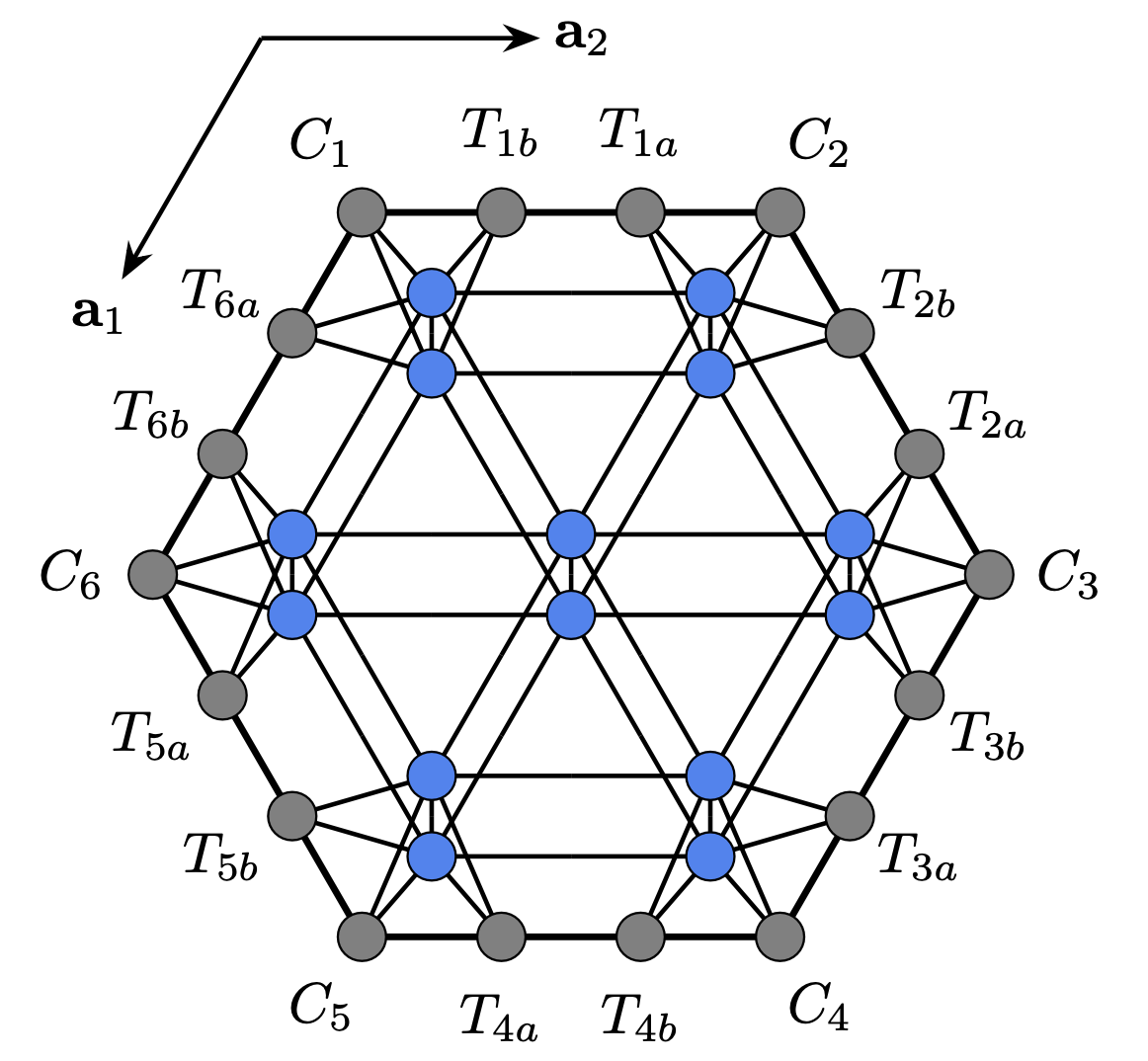
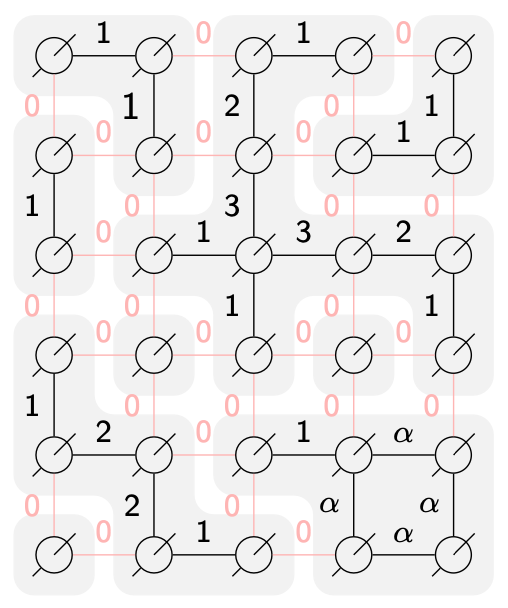
\[O(\Delta t) = e^{-i \Delta t H}\]Since this is exponentially hard in the system size, approximations are necessary. The traditional approach relies on the Suzuki-Trotter decomposition, but a more recent and accurate alternative is to use cluster expansions (see Figure 2) [3,4]. For both of these methods, the key challenge is to systemetically find accurate representations of this evolution operator at high values of \(t\). The cluster expansion method has up until now mostly been used for thermal states in an imaginary-time evolution approach, whereas here real-time evolution would be needed [5].
Goal
The thesis will explore different methods for simulating real-time evolution of a quantum system. Since the state-of-the-art methods are scarce in (2+1)-dimensional systems, the first step will consist of benchmarking the current methods on a simpler model. Depending on the interests of the student, the next step can be to either apply the methods used for the simple model to the tJ and Hubbard model to investigate the properties of these models and the materials they describe, or focus more on the development and implementation of different schemes that could be more performant.
[1] Qin M. (2021) arxiv:2104.00064
[2] Sinha A. (2022) arxiv:2209.00985
[3] Vanhecke B. (2021) arxiv:2112.01507
[4] Vanhecke B. (2019) arxiv:1912.10512
[5] De Meyer S. (2026) arxiv:2602.22113
Context
High-temperature superconductivity was first discovered in 1986 when a system of barium, lanthanum, copper, and oxide exhibited a critical temperature of 30K—then the highest recorded. However, BCS theory, the original framework for superconductivity, failed to explain this phenomenon. A complete theory of this effect is still missing, more than 40 years after its discovery.
To study and simulate superconductivity, the Hubbard model was introduced as a minimal model. It describes fermions hopping on a (in the case of the cuprates: square) lattice, with a hopping term and a repulsive term [1]
\(H = -t \sum_{<i j> \sigma} \left(\hat{c}_{i \sigma}^\dagger \hat{c}_{j \sigma} + h.c.\right) + U \sum_i \hat{n}_i \hat{n}_j\).
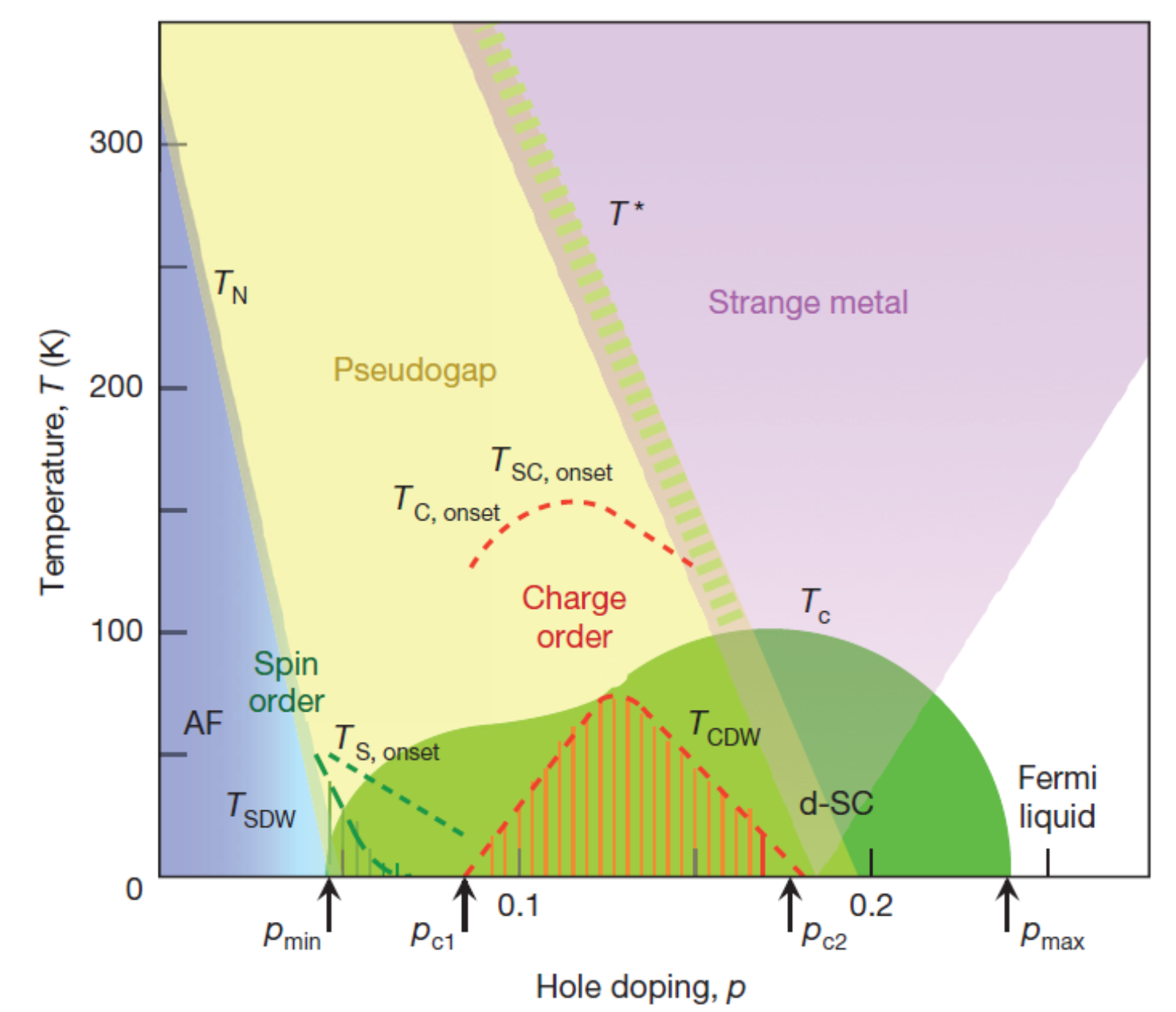
However, solving it remains a significant challenge, leading to the development of numerous computational approaches. Among these, Tensor Networks (TN) have emerged as a powerful tool, explicitly capturing strong correlations without suffering from the sign problem (like Quantum Monte Carlo methods). In particular, the two-dimensional TN variant, Projected Entangled-Pair States (PEPS), is widely used but has been primarily applied to ground-state (0K) calculations and static properties. To get more insight into the Hubbard model, it is crucial to extend these methods to finite-temperature states and their time evolution [2]. This would allow us to accuretly predict the finite-temperature phase diagram of the Hubbard model (Figure 1).
A key computational challenge in the latter is evaluating the exponential of the Hamiltonian. For finite temperatures, this requires computing the density operator:
\[\rho(\beta) = e^{-\beta H}\]Since this is exponentially hard in the system size, approximations are necessary. The traditional approach relies on the Suzuki-Trotter decomposition, but a more recent and accurate alternative is to use cluster expansions (see Figure 1) [3,4]. For both of these methods, the key challenge is to systemetically find accurate representations of this thermal state at high values of \(\beta\) (low temperatures).
Goal
This thesis will explore different methods for probing the finite-temperature phase diagram of the Hubbard model. There are multiple directions that could be taken depending on the interests of the student. One possibility is using the existing methodologies to study various parameter regimes of the Hubbard model, looking both at the feasibility and computational cost of obtaining accurate results. Another is working further on the development of these algorithms to further optimize their efficiency and accuracy. In both approaches, the first step will consist of looking at the strong-coupling limit of the Hubbard model, where the system can be modeled by the computationally less challenging tJ-model. Once the results of this model (which are interesting in their own right) are benchmarked, several different aspects of the Hubbard model can be investigated.
[1] Qin M. (2021) arxiv:2104.00064
[2] Sinha A. (2022) arxiv:2209.00985
[3] Vanhecke B. (2021) arxiv:2112.01507
[4] Vanhecke B. (2019) arxiv:1912.10512
[5] Czarnik P. (2018) arxiv:1811.05497
Context
Many interesting problems in and around physics can be formulated as the contraction of an infinite two-dimensional tensor network [1].
- Partition function of 2d classical models and (1+1)D quantum systems.
- Ground state entropy of 1d quantum mechanical systems.
- 2- (or more) point correlation functions.
- Counting problems like the perfect matching problem / dimer covering problem.
However, contracting an infinite tensor network exactly would require infinite computational resources. To address this, researchers have developed various approximate contraction techniques that achieve surprisingly high accuracy.
One common approach uses the ideas of the renormalization group to perform coarse-graining on tensors within a network. These techniques - Tensor Network Renormalisation (TNR) techniques - are well-established and serve as a useful benchmark for this thesis.
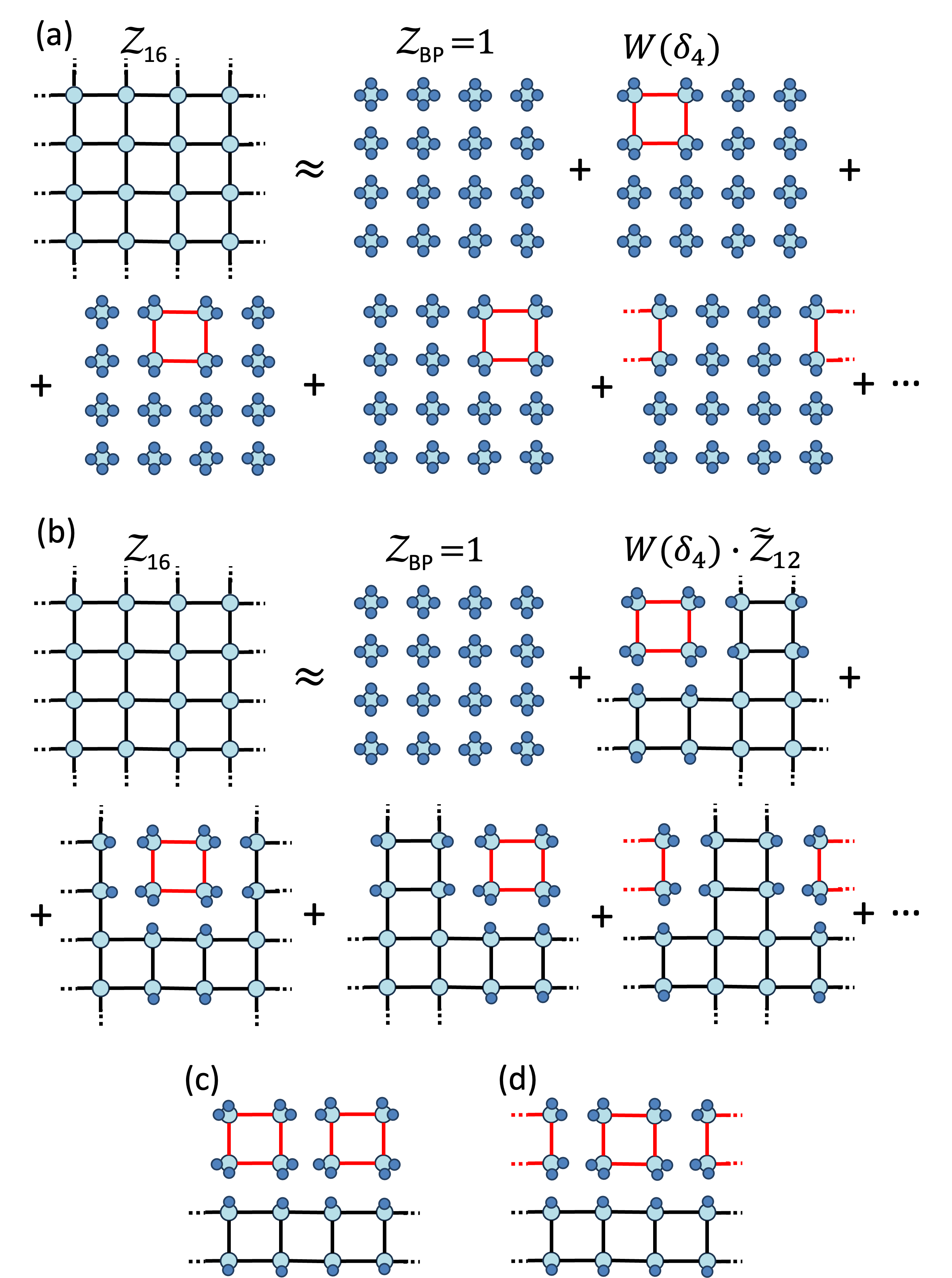
A promising alternative approach to contract 2d tensor networks, that borrows from statistical physics, is belief propagation (BP) [2]. It has been shown that BP is equivalent with a mean-field approximation to the problem. To increase its accuracy, researchers have put forward several improvements. Loop series expansions and loop cluster expansions to name a few [3, 4].
These novel methods remain an active field of research with many open questions to be answered and possible improvements to discovered.
Goal
This thesis will have a major numerical component, requiring programming in the Julia programming language (no prior knowledge required). It consists of three main objectives:
-
Implement belief propagation Implement belief propagation for the contraction of infinite 2D tensor networks and validate it against exact analytical results. We will make use of the TensorKit Julia library which makes writing tensor network code a breeze.
-
Systematic Benchmarking Against TNR Methods Perform a systematic comparison of BP-based contraction against established techniques (e.g. TRG, HOTRG) in terms of accuracy, computational cost, and scaling with bond dimension. Identify regimes where BP is competitive, and where it breaks down.
-
BP Improvements Implement several improvements on top of BP put forward by [3] and [4].
-
Exploration Explore novel improvements for BP and/or come up with hybrid TNR/BP methods.
References
[1] Bridgeman, J. (2016) arxiv.org:1603.03039
[2] Alkabetz R. (2020) arXiv:2008.04433
[3] Evenbly, G. (2024) arxiv.org:2409.03108
[4] Gray J. (2025) arXiv:2510.05647
Context
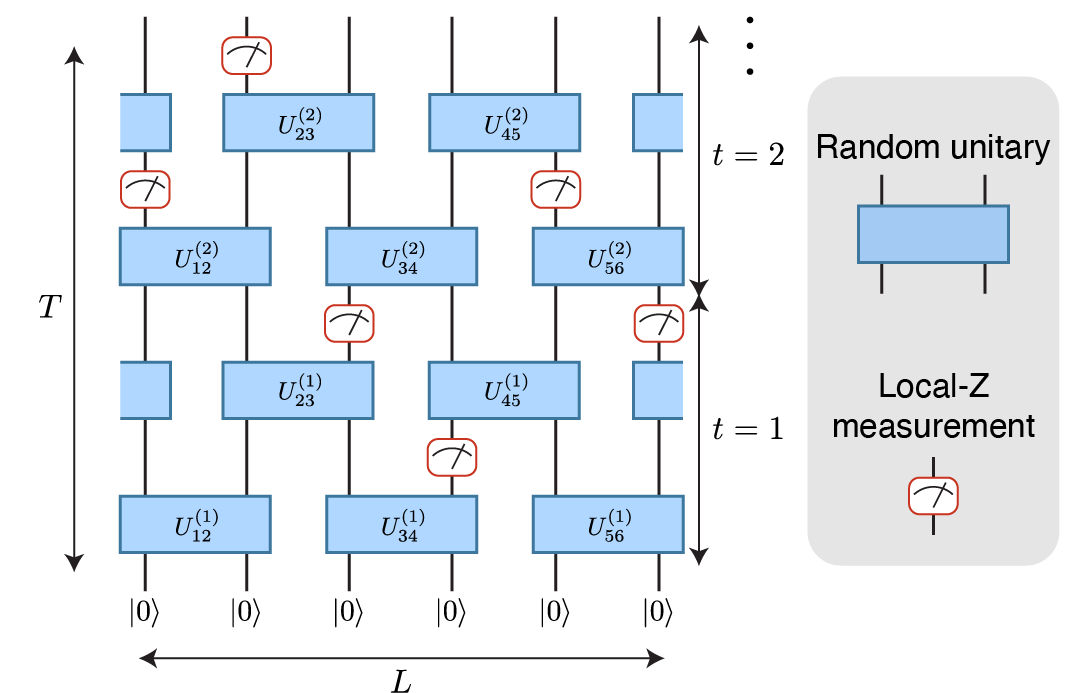
In classical circuit, one can use a series of binary code (i.e., ‘0’ and ‘1’) to represent the information and use logic gate to realize all kinds of operations. While in quantum circuit, the binary code is replaced by the quantum state (i.e., ‘|0>’ and ‘|1>’ in Fock space) and the gate operation becomes local unitary evolution. From a product state, the system can generate long-range entanglement after a long enough unitary evolution, while the measurement (local Hermitian projection) could reduce it. Thus, one should expect there is a Measurement-Induced Phase Transitions (MIPT) [1-3]. However, most of the recent quantum circuit research focus on the bosonic states and operations (i.e., hard core bosons) and fermionic quantum circuit which shares the same Hilbert space seems less attractive. The reason can come from the redundancy of Jordan-Wigner string in a matrix product operator (MPO) which is the main tool used. If one is familiar with the Projective Quantum Monte Carlo (PQMC) [5], he/she should find out it is a perfect tool to study fermionic quantum circuit since there is an isomorphic mapping. The decoupled repulsive interaction corresponds to the unitary evolution, and the kinetic term becomes the Hermitian projection. The interesting observations in bosonic quantum circuit like MIPT should also be expected in a fermionic quantum circuit with a potentially different critical behavior.
Goal
The goal of this thesis is to explore the possibility of simulating a fermionic quantum circuit within PQMC framework. A first step could be comparing the one-dimensional critical behavior of MIPT between fermionic and bosonic random quantum circuit. Due to PQMC has no dimensional limitation from entanglement area law, one can also study the critical behavior in higher dimension (e.g., two-dimension) fermion quantum circuit.
References
[1] Fisher, M.P., Khemani, V., Nahum, A. and Vijay, S., arXiv:2207.14280
[2] Skinner B, Ruhman J, Nahum A., arXiv:1808.05953
[3] Li Y, Chen X, Fisher M.P., arXiv:1808.06134
[4] Li Y, Chen X, Fisher M.P., arXiv:1901.08092
[5] F Assaad, H Evertz, Computational many-particle physics
High Energy Physics
Context
Experimental measurements at the Large Hadron Collider (LHC) are reaching unprecedented precision, a trend that will intensify during the High-Luminosity LHC upgrade. At the same time, the high collision energies of the LHC, together with the strength of the Quantum Chromodynamics (QCD) interaction, mean that proton-proton collisions produce many particles in the final state. Providing sufficiently precise theoretical predictions for cross-sections at the LHC is challenging because it requires evaluating scattering amplitudes – sums of many, complicated Feynman diagrams – whose complexity grows rapidly with the required precision and number of particles involved.
Modern methods compute scattering amplitudes numerically using sophisticated mathematical and computer-algebra techniques, but the resulting evaluations are often too slow to be used efficiently in large-scale cross-section calculations across phase space. In practice, however, the amplitudes do not need to be known to extremely high precision – an accuracy at the level of roughly one part in ten thousand is typically sufficient for phenomenological applications. To meet experimental needs, an approach that has recently attracted attention [1] is to understand whether numerical evaluations of amplitudes can be used to construct approximations that accurately reproduce the amplitudes across phase space while avoiding the high computational cost of traditional techniques.
This problem can be seen as a machine learning challenge, where scattering amplitudes are learned and modelled across a high-dimensional phase space, using a relatively small number of samples.
Goal
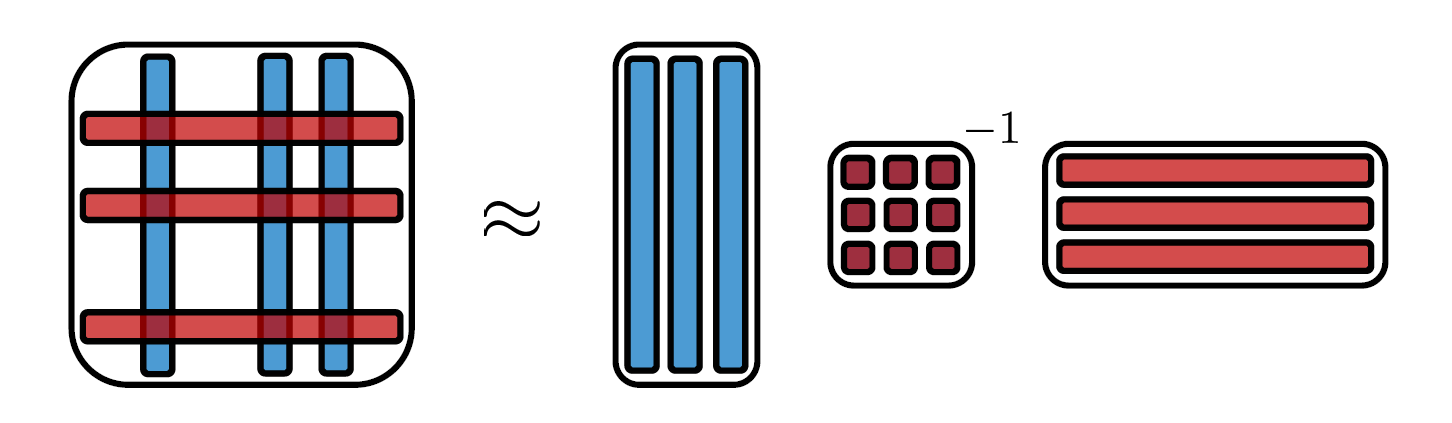
In this project, we will investigate interpolation methods for constructing efficient approximations of scattering amplitudes across phase space. In particular, we will explore a recently developed technique, known as tensor cross interpolation [2], that enables the efficient construction of low-rank representations of high-dimensional functions. This “quantum-inspired” approach [3] is based on tensor networks, a framework that was originally developed to model ground states of quantum many-body systems, but that is increasingly being used for a variety of machine learning applications. In particular, tensor cross interpolation techniques exploit hidden structures in multivariate functions in order to learn accurate tensor network approximations that require far fewer function evaluations than traditional interpolation methods. The goal is to assess whether such methods can be used to learn fast surrogate models of scattering amplitudes from numerical data, reproducing the amplitudes across phase space with the accuracy required for phenomenological applications while significantly reducing computational cost. These techniques were recently applied successfully in the context of some typical problems in condensed matter physics [4,5], but in this thesis, the student will investigate these techniques and apply them to several state-of-the-art scattering amplitudes relevant for phenomenology at the Large Hadron Collider, thereby gaining experience in modern numerical techniques and scientific programming.
References
[1] Bresó-Pla, V. (2025) arXiv:2412.09534
[2] Núñez Fernández, Y. (2025) arXiv:2407.02454
[3] Waintal, X. (2026) arXiv:2601.03035
[4] Núñez Fernández, Y. (2022) arXiv:2207.06135
[5] Waintal, X. (2026). arXiv:2602.03598