Frank Verstraete

Frank Verstraete

Leigh Trapnell Professor of Quantum Physics, Department of Applied Mathematics and Theoretical Physics, University of Cambridge · Professor of Physics, Ghent University

Nobody understands quantum physics. Everybody understands linear algebra. My life's work — the field of tensor networks, founded with Ignacio Cirac two decades ago — is the systematic conversion of the first problem into the second, tearing down, in the process, the infamous exponential wall of many-body physics.

Tensor networks

Here is the trouble with quantum mechanics: to describe a handful of particles exactly, you need more numbers than there are atoms in the universe. That should be the end of the story. And yet your table is solid, the sun shines, and your laptop's transistors switch faithfully many billions of times per second. Nature clearly does not bother with all those numbers. The reason is entanglement: of that unimaginably vast space of possibilities, nature only ever visits a tiny corner, and tensor networks are the coordinates of that corner. What began as one numerical trick is now a research field of its own: the common language of computational quantum physics, quantum information and much of condensed matter theory, and the yardstick against which quantum computers are measured.

Over the past two decades, my collaborators and I have been the principal architects of the modern tensor-network field and introduced the basic vocabulary of it:

Projected entangled pair states (PEPS) Matrix product operators (MPO) Continuous matrix product states Fermionic & graded tensor networks Projected entangled pair operators (PEPO) Tangent-space methods & TDVP MPO symmetry algebras & dualities

Tensor networks are now leaving the seminar room. They are how one simulates, verifies and (embarrassingly often) outperforms near-term quantum hardware, and how the many-body problems of chemistry and materials get compressed to something a computer, classical or quantum, can actually hold.

Research

I work on the interface between quantum information theory and quantum many-body physics. The recurring theme (colleagues would say the recurring joke) is the reformulation of seemingly intractable problems in quantum physics as problems in linear algebra. Call it algebracadabra. The feature of quantum mechanics that makes many-body problems hard, entanglement, is precisely the feature that, once understood, makes them tractable. And no, human intuition is not much help here; it is, as we put it in the book, a terrible guide in physics. Mathematics is the better one.

Entanglement

Entanglement as the unifying language for strongly correlated quantum systems. This started with a classification problem (in how many ways can four qubits be entangled?) which turned out to be a question posed by Le Paige in 1881 and advanced by Segre in 1922. It resisted invariant theory; it fell to linear algebra.

Variational physics

Physics on the manifold of matrix product states and PEPS: faithfulness theorems, matrix product operators, continuous MPS for quantum fields, and the tangent-space methods, in which excitations, real-time dynamics and optimization are all statements about tangent vectors.

The algebra of the tensors

The local tensor as an object of study in its own right: a single small tensor repeated across a lattice already fixes the global physics — fermionic statistics, topological order, which symmetries can act. This leads to graded tensor networks, matrix product operator algebras, dualities, and most recently the question of what is the group of a quantum group.

Quantum computation

Quantum computation by dissipation, quantum circuits for integrable systems, and the quantum Metropolis algorithm: what a quantum computer is actually good for when the problem is a many-body Hamiltonian.

My group works between Cambridge and Ghent — see QuantumGroup@UGent.

Selected papers

Four qubits can be entangled in nine different ways
Verstraete, Dehaene, De Moor, Verschelde
Four qubits can be entangled in nine different ways
Phys. Rev. A 65, 052112 (2002)
A problem from 1881, solved by turning it into linear algebra.
Renormalization algorithms for quantum many-body systems in two and higher dimensions
Verstraete, Cirac
Renormalization algorithms in two and higher dimensions
arXiv preprint (2004)
The PEPS paper. Never formally published, as "too many notes"; cited more than thousand times anyway.
Matrix product states represent ground states faithfully
Verstraete, Cirac
Matrix product states represent ground states faithfully
Phys. Rev. B 73, 094423 (2006)
Why DMRG works: a rigorous justification.
Quantum computation and quantum-state engineering driven by dissipation
Verstraete, Wolf, Cirac
Quantum computation driven by dissipation
Nature Physics 5, 633 (2009)
Noise, usually the enemy, promoted to computational resource.
Continuous matrix product states for quantum fields
Verstraete, Cirac
Continuous matrix product states for quantum fields
Phys. Rev. Lett. 104, 190405 (2010)
Tensor networks without the lattice.
Time-dependent variational principle for quantum lattices
Haegeman, Cirac, Osborne, Pižorn, Verschelde, Verstraete
Time-dependent variational principle for quantum lattices
Phys. Rev. Lett. 107, 070601 (2011)
Dynamics as geometry: evolution projected onto the tangent space.
Characterizing topological order with matrix product operators
Şahinoğlu, Williamson, Bultinck, Mariën, Haegeman, Schuch, Verstraete
Characterizing topological order with matrix product operators
Annales Henri Poincaré 22, 563 (2021)
Topological order read off from the algebra of the tensors.
Dualities in one-dimensional quantum lattice models: symmetric Hamiltonians and matrix product operator intertwiners
Lootens, Delcamp, Ortiz, Verstraete
Dualities in one-dimensional quantum lattice models
PRX Quantum 4, 020357 (2023)
Kramers–Wannier and its relatives, as explicit matrix product operators.

Full list on arXiv and Google Scholar.
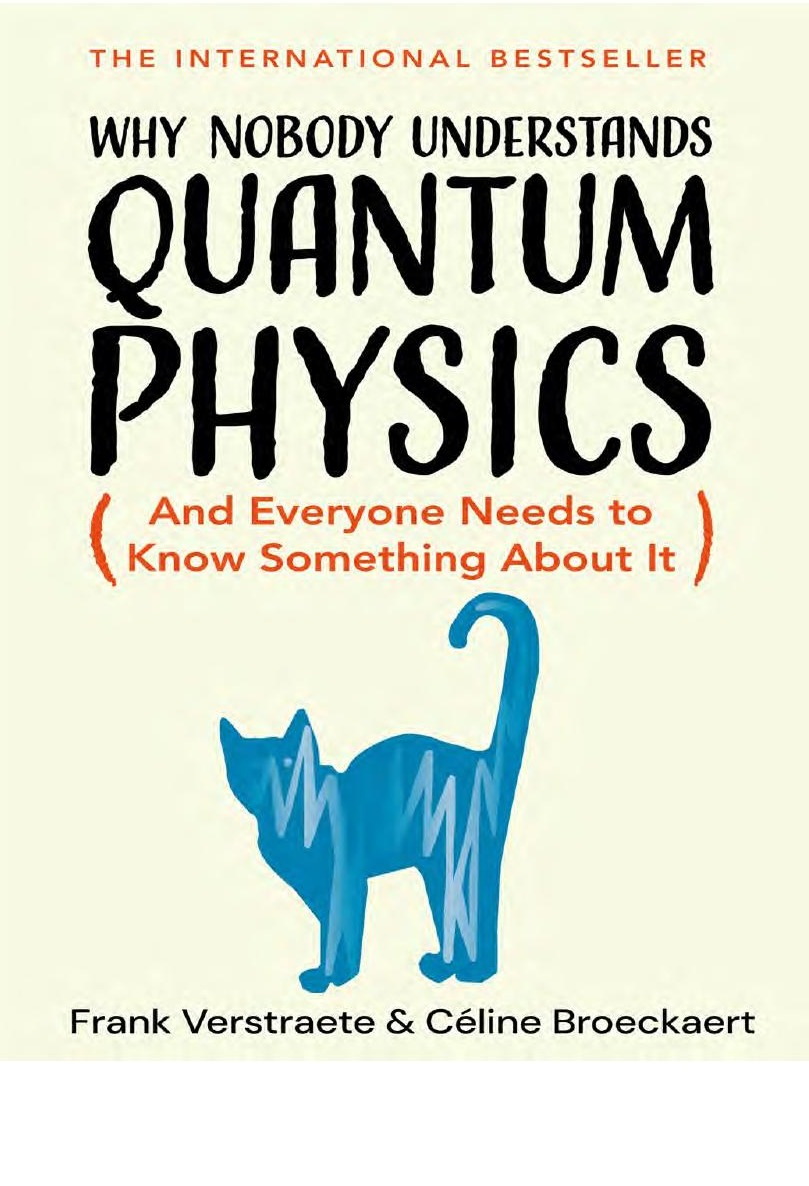
Why Nobody Understands Quantum Physics — cover

Why Nobody Understands Quantum Physics

With Céline Broeckaert I wrote a book about the strangest and most successful theory we have — for everyone who was ever told it was beyond them. It isn't. The complexity of quantum physics must never be used to mystify it. The book is now published in eight languages, and Waterstones selected it among the best popular science books of 2025.

“Frank thinks and speaks in mathematics; I think and speak in words.” — Céline, in the writer's foreword

Visit the book site →

Short vita

  • 2022–  Leigh Trapnell Professor of Quantum Physics, University of Cambridge
  • 2012–  Professor of Physics, Ghent University (Odysseus grant, FWO)
  • 2006–2012  Professor and chair of theoretical quantum nanophysics, University of Vienna
  • 2004–2006  Postdoc, Caltech (group of John Preskill)
  • 2002–2004  Postdoc, Max Planck Institute of Quantum Optics (group of Ignacio Cirac)
  • 2002  PhD, KU Leuven — A study of entanglement in quantum information theory
  • Francqui Prize (2018)
  • Lieben Prize (2009)
  • Hermann Kümmel Early Achievement Award in Many-Body Physics
  • ERC grants (2009, 2015, 2023)
  • Distinguished Visiting Research Chair, Perimeter Institute

Contact

Cambridge
DAMTP, Centre for Mathematical Sciences
Wilberforce Road, Cambridge CB3 0WA, UK
fv285@cam.ac.uk

Ghent
Department of Physics and Astronomy
Krijgslaan 281, 9000 Gent, Belgium
frank.verstraete@ugent.be

Elsewhere
QuantumGroup@UGent
DAMTP profile
Wikipedia